Budget planning for a sustainable future
Like many school districts across Pennsylvania, we are facing declining enrollment and rising costs that are growing faster than revenues. These factors have created a structural imbalance that requires thoughtful, sometimes difficult decisions.
This Budget Information Hub brings together background, data, timelines, and opportunities for community input in one place. We will continue to update this site throughout the budget process.
The district’s current budget challenge is not the result of a single decision or a single year. It reflects a long‑term structural imbalance between how much it costs to operate the district and how much revenue we receive.
On average, district expenses have been increasing by about 6% per year, driven by factors such as employee benefits, special education services, transportation, and utilities. At the same time, our primary local revenue source—property taxes—grows by less than 1% annually unless tax rates are increased.
Compounding this challenge is the nature of our local tax base. A significant portion of property in the community is tax‑exempt, including hospitals, colleges, churches, and major economic development projects. While these assets provide important benefits, they do not contribute to property tax revenue that supports schools.
Over time, this gap between steadily rising costs and limited revenue growth has widened, creating the financial pressure we must now address.
Declining Enrollment
The district’s overall enrollment is declining, down more than 10% since 2017. These 1,200 students represent the equivalent of about three average SDoL elementary schools.
At the same time, the district’s professional staff–which includes classroom teachers, specialists, and employees who work directly with students, such as social workers–has grown by 13% over the same span. This disproportionately low student:staff ration puts enormous strain on the district’s budget.
Addressing past overspending
The district has overspent its budget every year since 2021. To pay for these annual deficits, the district has drawn down its unassigned fund balance, or savings account, from a high of $30.6 million in 2020 to a negative $9.6 million at the beginning of this year.
It is important to understand how these issues relate. Our structural imbalance is the underlying issue that has contributed to overspending over the past several years, compounded by admittedly poor financial projections during the most recent fiscal year. The district is actively addressing last year’s overspending through one-time corrective actions such as spending freezes, debt refinancing, and stronger financial controls. Those steps are already in place.
However, the budget decisions being considered for future years are focused on addressing that underlying structural imbalance, not simply reacting to a single year’s financial outcome.
Spending by the numbers
For illustration purposes, these numbers track the flow of a $282.6 million budget for the School District of Lancaster. They illustrate how the vast majority of district funds–more than 92%–would be immediately diverted into four areas of mandated or otherwise fixed expenditures, the largest of which is salaries and benefits for staff.
The last area, considered “all other” operational expenses, is the area where the district has the largest amount of discretion. This area includes things like all classroom materials, technology, student transportation, before- and after-school programming, and field trips.
Note, this is for illustration only. The final budget amounts will be determined by the board.
$202.9m
Salaries and benefits
$24.1m
Debt service
$17.3m
Charter, cyber, and other tuition payments
$15.8m
Utilities and maintenance of buildings and grounds
$22.5m
All remaining district expenses
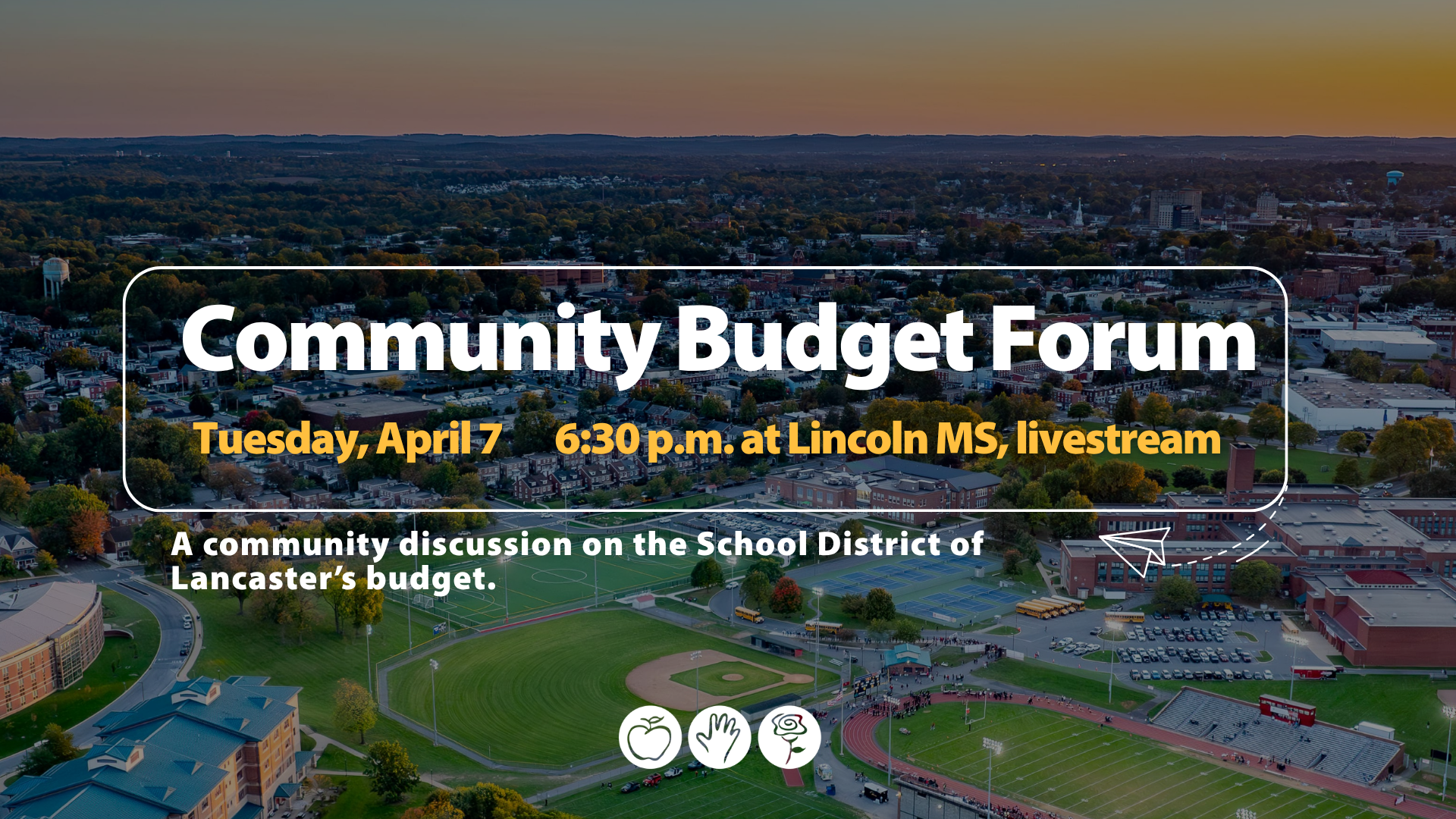
The district administration is scheduled to present a series of budget options at the Community Budget Forum on April 7, 2026. The presentation will be posted for public view on BoardDocs prior to the budget meeting. The information will be summarized here following the meeting.
The documents below show how the district’s budgets have evolved in recent years as enrollment, costs, and revenues have changed. Annual budgets reflect financial assumptions made at a specific point in time. As enrollment, service needs, and economic conditions change, actual costs may differ from initial projections. These documents are provided for transparency and context.
Updates
This section includes key documents and updates related to the district’s budget planning. Materials are added as they become available.
March 25, 2026
Dear SDoL families,
I am writing to share an update following last night’s School Board meeting and to invite you to continue participating in the district’s budget planning process.
At the meeting, the School Board unanimously approved a resolution of intent related to potential furlough authority, as required under Pennsylvania law. This resolution allows the district to consider furloughs if they become necessary during the budget process due to declining enrollment and ongoing financial pressures. The resolution is a procedural step—it does not implement furloughs, and no final decisions have been made about staffing or programs.
The next step in this process is to share strategies to begin closing our structural deficit for the board to consider at a Community Budget Forum on April 7. During this meeting, families and community members are invited to:
- Learn more about the district’s financial challenges,
- Hear how recent financial issues are a symptom of a deeper, long‑term budget imbalance the district is now working to address,
- Review budget options under consideration, including reductions and investments, and
- Talk directly and share suggestions with district leaders and subject‑matter experts.
At the same time, we are working on building a new section of our website that will collect past budget information in one easy-to-find place, as well as all updates and information on the current budget process, including strategies to address our structural deficit when they are announced.
We recognize that budget discussions can be concerning, especially when they involve staffing and programs that support students. The board and administration remain committed to being transparent about the challenges we face and engaging the community throughout the budget process.
Thank you for your continued support of our schools. We will continue to share updates as the process moves forward.
Sincerely,

Keith Miles Jr.
Superintendent of Schools
School District of Lancaster
March 20, 2026
Dear SDoL Families,
We are writing to share important information about ongoing budget discussions in our district and to provide clarity about what has been shared publicly and in recent media coverage.
On Tuesday evening, the School Board discussed a proposed resolution that would allow the district to consider staff reductions, if necessary, during this budget cycle due to declining student enrollment and financial pressures affecting school districts across Pennsylvania. After discussion, the Board voted to table the resolution and will continue the conversation at a special meeting on March 24 at 6:30 p.m.
We know that news reports and online discussions have raised concerns, and we want to be transparent and thorough in explaining our situation and our approach.
Understanding the Budget Challenge
Our district, like many others, is facing a long-term budget challengecaused by two key factors:
- Declining student enrollment, and
- Costs that continue to increase faster than revenues.
Over time, this imbalance has created a structural deficit, meaning that, even with responsible budgeting, our current model is not sustainable. On average, our expenses increase by about 6% each year, driven by driven by factors largely outside the district’s control, including employee benefits, special education services, transportation, utilities, and contractual obligations. At the same time, our primary local revenue source—property taxes—grows by less than one percent annually unless the district raises tax rates.
Federal COVID relief funds gave us a reprieve from this reality, but those funds are gone. This long-standing challenge is what is driving the difficult budget conversations now underway.
Some coverage has connected this year’s budget planning to last year’s overspending. While we take that issue seriously, it is important to understand how these issues relate. Our structural imbalance is the underlying issue that has contributed to overspending over the past several years, compounded by admittedly poor financial projections during the most recent fiscal year. The district is actively addressing last year’s overspending through one-time corrective actions such as spending freezes, debt refinancing, and stronger financial controls. Those steps are already in place.
However, the budget decisions being considered for future years are focused on addressing that underlying structural imbalance, not simply reacting to a single year’s financial outcome.
How Decisions Will Be Made
No final budget decisions have been made. Over the next few months, the district will present budget options for Board consideration that include:
- Proposed reductions and cost savings,
- Required and recommended investments, and
- An explanation of the tradeoffs involved in each option.
To support transparency and accountability, the district has engaged independent financial professionals who are reviewing our business and financial operations. Their findings will help guide both immediate improvements and long-term planning.
We invite you to attend our Community Budget Forum, which is scheduled for April 7, where families and community members will have an opportunity to:
- Learn more about the district’s financial situation,
- Understand the budget options under consideration, and
- Ask questions and share feedback before decisions are made.
We encourage families to participate in that conversation.
Our Commitment
We recognize how unsettling budget discussions can be, especially when they involve staffing and programs that matter deeply to students and families. We are committed to transparency about our challenges and choices, communicating clearly and regularly as the budget process continues.
Thank you for your continued engagement and support of our schools.
Sincerely,
Keith Miles Jr.
Superintendent of Schools
School District of Lancaster
February 10, 2026
Additional Documents
-
Multi-Year Budget Strategy
A blueprint for bringing the district to structural balance, presented to the school board February 10, 2026.
-
Deficit Mitigation Strategy & Financial Recovery Plan
An overview of tactics to address the district's budget deficit from the 2024-2025 school year, presented to the school board on February 24, 2026
-
Annual Comprehensive Financial Reports
An archive of Annual Comprehensive Financial Reports dating back to 2019.