At Fulton Elementary School, learning recently moved beyond the page and into students’ hands, imaginations, and lived experiences.
Through a partnership with WITF and Pennon Education, kindergarten through third grade students took part in a multi-week series of developmentally appropriate, standards-aligned STEM lessons that blended literacy, science, engineering, and technology. Each experience was designed to help students explore real-world phenomena while building skills that support long-term college and career readiness.
Each lesson began with a shared story. Students listened as educators read aloud, grounding complex concepts in narrative and language. At the end of every session, each child received a copy of the book to take home, extending learning beyond the classroom and strengthening the connection between school and family.
“They would start with the book, and then everything connected back to it,” Mary Sotomayor, Fulton ES counselor shared. “The lessons were always interactive. Robotics, biology, building, VR. And the kids got to keep the books, which made it feel really meaningful.”

First grade classrooms explored how sound travels through vibrations using tuning forks tested in air, water, sand, and paper. Students then became engineers, designing playground equipment inspired by biomimicry and how tree roots stabilize trees. Their final lesson introduced hydroponics, where students designed plant holders to support indoor growing systems and continued observing plant growth with their classroom teachers.
Second graders examined ecosystems and materials through movement and code. Using Bee-Bots, students practiced coding while learning about pollination. Ozobots helped illustrate seed dispersal, and Spheros modeled how water travels through watersheds from mountains to oceans. In their final lesson, students explored textiles and learned how engineers test materials to determine the best fit for specific uses.
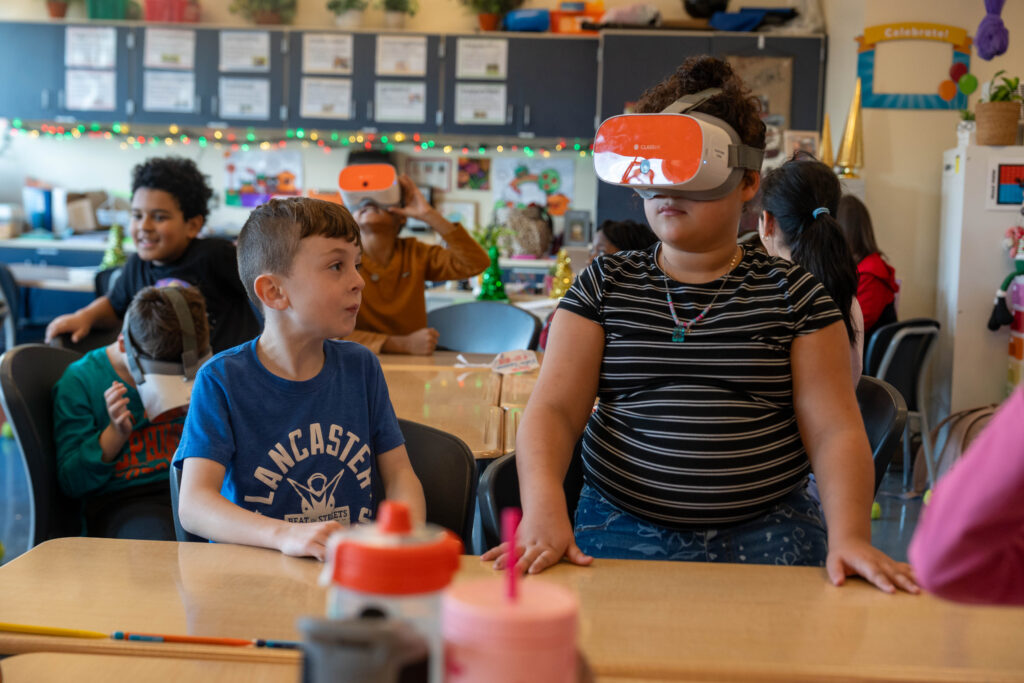
Third graders tackled even more complex systems. They studied animal cooperation by building bridges inspired by ant colonies, explored magnetism by creating their own compasses, and learned how Earth’s magnetic field helps with navigation. Through virtual reality, students examined how urbanization impacts the environment and communities over time, then designed spaces that balance urban growth and farming before taking a virtual field trip to a rooftop garden.

“These experiences stay with kids,” Sotomayor said. “We can meet requirements through online platforms or big assemblies, but are those really sticking? Probably not. This kind of learning does. It’s something they’ll remember for the rest of their lives.”
Sotomayor hopes this partnership is only the beginning. WITF and Pennon Education currently serve schools across the Harrisburg and York regions and are eager to expand their work throughout the School District of Lancaster. Teachers and schools interested in bringing similar experiences to their classrooms are encouraged to connect.